

How Much Does a Custom 3D Product Configurator Cost in 2027? Pricing, Features & Hidden Costs
A custom 3D product configurator can cost a few thousand dollars for a limited visual experience, or require a substantially larger investment when it needs complex rules, live quotations, multiple product families, and business-system integrations. The difference is not simply how realistic the 3D model looks. It is what the application must let customers choose, what the business must calculate, and what happens after someone submits a configuration.
For planning a 2027 project, publicly advertised 2026 supplier prices offer useful reference points. SBFS lists one-time setups ranging from $2,500 to $5,000 for its Entry tier to $50,000+ for an integrated Forge platform, with monthly charges in addition. ComeFigure advertises a $4,999 starting price for a limited custom project, while Grup3D advertises development from €6,500 and commonly quotes €14,500 to €35,000 for manufacturer projects. These are examples of different suppliers' offers, not a universal market average or a Darul Solutions rate card. You can review SBFS pricing, ComeFigure's published guide, and Grup3D's implementation guide directly.
This guide explains what those numbers include, how WebGL and Unreal Engine change the cost structure, where hidden expenses arise, and how manufacturers can get an estimate that reflects their actual products. The benchmarks were checked in November 2026; 2027 contracts and renewal rates may differ.
How Much Does a Custom 3D Product Configurator Cost?
The most useful first question is not "How much is a 3D configurator?" but "What kind of configurator does our sales and production workflow require?" A single-item product visualizer, a rules-driven quotation tool, and an enterprise CPQ system are three different investments.
Basic Visual Configurator: One Product Family
At the simpler end, customers may rotate a product, switch colors or finishes, choose from predefined options, and submit a request. The scope is limited, the catalog is relatively small, and pricing may be handled outside the experience. This can work for launches, simple furniture ranges, single-product retail campaigns, and an initial proof of concept.
For one real-world reference, SBFS publishes a $2,500 to $5,000 Entry setup and a monthly service charge. ComeFigure publishes a $4,999 starting point for a single-product custom build. Both are provider-specific offers whose deliverables need to be checked before comparison. Review SBFS pricing and ComeFigure's pricing explanation for details.
Advanced Configurator: Product Rules and Quotation Workflows
An advanced implementation may support multiple products, dependent options, configurable dimensions, saved designs, lead capture, and pricing logic. Development becomes more demanding when a choice affects several other choices: for example, when a different frame size changes available doors, hardware, materials, or shipping requirements.
SBFS publicly lists $6,000 to $12,000 for its Mid tier and $20,000 to $40,000 for its Parametric tier, plus continuing charges. Grup3D reports that many of its manufacturer projects fall between €14,500 and €35,000. These prices describe different offerings, so scope, not the headline number, should drive comparisons. See SBFS and Grup3D.
Enterprise Configurator: CPQ, Data Integration and Scalability
For complex manufacturing, the configurator may need approved product rules, region-specific prices, dealer accounts, role permissions, quotations, customer records, ERP integration, and production-ready output. At that point it is as much a business application as a visual tool.
SBFS advertises its Forge tier from $50,000, while Threekit states that its platform pricing is custom according to use case, product count, visualization and scope. Treat enterprise estimates as project-specific and ask suppliers to separate implementation, licensing, hosting and support. See SBFS and Threekit pricing.
| Delivery level | Typical functionality | Example published supplier pricing | Best fit |
|---|---|---|---|
| Visual starter | One product family, simple options, interactive 3D view | SBFS Entry: $2,500 to $5,000 setup + monthly fees | Limited catalog or pilot |
| Rules + quoting | Multi-option configuration, dependencies, lead/quote workflow | SBFS Mid: $6,000 to $12,000; Parametric: $20,000 to $40,000 + monthly fees | Growing manufacturers |
| Integrated platform | CPQ, dealer logic, ERP/CRM integration, scalable catalog | SBFS Forge: $50,000+; Threekit: custom quote | Enterprise operations |
Pricing note: The table is not a Darul Solutions price list, nor is it an independent average. It quotes selected public supplier examples checked in November 2026. Taxes, assets, operating fees and scope may be excluded. Obtain a written, comparable statement of work before choosing a vendor.
What Are You Actually Paying for in 3D Configurator Development?
The visible 3D scene is only one part of the delivery. For many manufacturers, the more difficult work is accurately translating product knowledge into a reliable configuration system.
Discovery and Experience Design
The first phase establishes who will use the configurator, what decisions they need to make, which products are eligible, how options are organized, and what constitutes a completed inquiry or order. A good discovery phase produces a product matrix, interaction specification, technical architecture and clear acceptance criteria. Without it, teams often discover late that apparently simple product options are mutually dependent.
3D Modeling and Optimization
A manufacturer may already own CAD files, but CAD assets are not automatically suitable for real-time delivery. Geometry often needs cleanup, materials need preparation, and textures and file sizes must be optimized. A product with ten selectable finishes does not necessarily need ten separately modeled assets, but a catalog with materially different geometry may require multiple meshes or rule-driven assembly.
Frontend, Configuration Logic and Backend Systems
The interactive view must communicate with a reliable data model. That means defining the permissible combinations, recording the user's choices, calculating estimated prices when appropriate, and sending accurate records to the next system. A beautiful model with invalid product combinations is not a finished sales configurator.
QA, Deployment and Handover
The developer should test representative product combinations, small screens, low-powered devices, pricing edge cases and backend failures. Include a plan for content updates, source-code ownership, asset management, analytics and post-launch support.
Need a clear technical blueprint for your catalog? Darul Solutions scopes custom 3D web configurators with transparent deliverables and zero lock-in.
Seven Factors That Influence 3D Configurator Pricing
1. Number of Models and Variants
One configurable chair with five fabrics is not equivalent to a kitchen catalog with hundreds of modules. What matters is the number of genuinely distinct geometries and the rules connecting them, rather than multiplying every possible color-and-size combination into an impressive but misleading variant count.
2. Complexity of Product Rules
Color swaps are relatively straightforward. Rules that enforce structural dimensions, accessory compatibility, material restrictions, quantity breaks, safety constraints or production tolerances require more analysis, development and testing. Manufacturer documentation is often the biggest input to this work.
3. Quality of Existing CAD and 3D Assets
Usable source geometry can reduce modeling work, but asset condition must be checked. Complex CAD assemblies may need retopology, mesh consolidation, texture baking and conversion to suitable delivery formats. Ask whether asset creation, revisions, localization and future product additions are included in the estimate.
4. Rendering Quality and Interactions
High-end automotive paint, gemstone optics, fabric textures and architecture-grade lighting can add substantial visual development. So can interactive cameras, exploded views, animation, interior walkthroughs and augmented-reality functionality. Define the level of realism needed to sell the product rather than pursuing maximum fidelity by default.
5. Live Pricing, Quotes and CPQ
A visually selected option does not automatically generate a commercially valid price. Live pricing needs an authoritative price list, discount rules, surcharges, dealer settings, taxes and often location-dependent calculations. Configure, Price, Quote (CPQ) workflows may also generate structured quotations and bills of materials. The configuration engine should validate combinations before a quote is issued.
6. CRM, ERP and E-Commerce Integrations
Shopify or WooCommerce may be sufficient for a direct-to-consumer catalog, while an industrial manufacturer may need Salesforce, HubSpot, an ERP, dealer software or a proprietary quotation service. Integration effort rises with legacy data formats, authentication, synchronization, rate limits and exception handling. Confirm exactly which system owns prices, inventory and product rules.
7. Hosting, Performance, Security and Maintenance
Browser-native 3D and GPU-streamed experiences have different recurring costs. Plan for monitoring, content delivery, backups, security updates, analytics, browser compatibility and changing product catalogs. Your quote should separate initial delivery from future operational commitments.
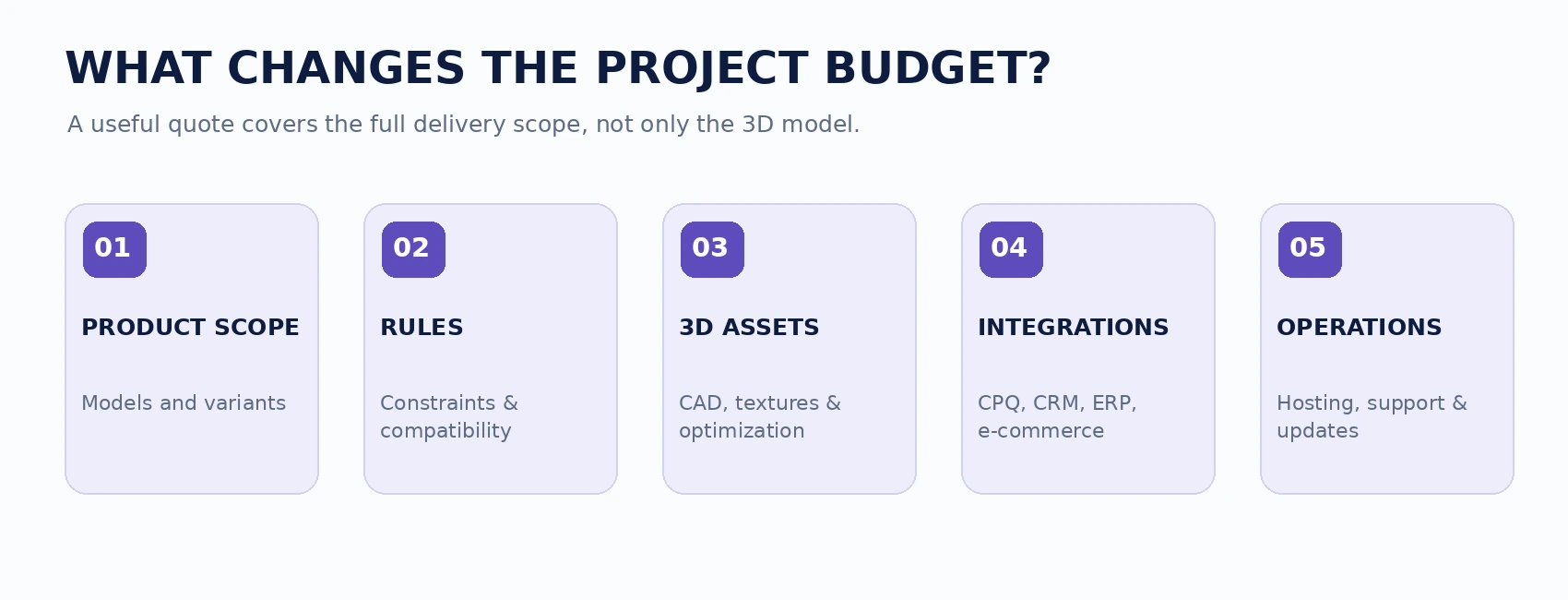
Product Scope
Distinct geometries, parametric ranges, and catalog families.
Rules & Logic
Structural constraints, dependencies, and validation guardrails.
3D Assets
CAD preparation, mesh retopology, materials, and Draco compression.
Integrations
Live CPQ dynamic pricing, CRM, ERP, and e-commerce checkout.
Operations
Hosting architecture, monitoring, updates, and SLA support.
WebGL vs Unreal Engine: Which Costs More?
The short answer is that there is no universal price winner. The correct comparison is total delivery and operating cost for a specific user experience.
WebGL and Three.js: Rendering on the Customer's Device
With WebGL and libraries such as Three.js, the browser normally performs the rendering. This can reduce the need for a dedicated remote GPU session per customer, but it places importance on mobile optimization, asset delivery, device support and front-end engineering. It is often suitable for furniture, building products, retail variants and accessible website-based configuration. Review the Three.js documentation for technical fundamentals.
Unreal Engine: Immersive Applications and Remote Rendering
Unreal Engine can be attractive when the experience needs highly detailed environments, advanced lighting or complex interactive presentations. When delivered through Pixel Streaming, the Unreal application runs on suitable remote hardware and streams its output to the user's browser. This adds infrastructure considerations such as GPU capacity, concurrency, bandwidth, networking, session management and operational support. Epic Games' Pixel Streaming hosting guide explicitly describes these deployment considerations.
| Cost consideration | WebGL / Three.js | Unreal Engine + Pixel Streaming |
|---|---|---|
| Rendering location | Generally visitor device GPU | Remote application / GPU infrastructure |
| Initial build | Depends on assets, rules and UI complexity | Depends on scene, interactions and stream architecture |
| Hosting model | Standard web hosting, CDN, APIs and assets | GPU compute, signaling servers, networking, frontend and APIs |
| Mobile reach | Depends on client device and optimization | Depends on network conditions and streamed video feed |
| Concurrent visitors | Often more scalable without one GPU session per visitor | Must profile sessions, GPU usage and concurrent capacity |
| Suitable use cases | E-commerce, configurable products, web catalog | Immersive showroom, architectural and complex presentations |
A fair proposal should show first-year and ongoing hosting assumptions for the chosen architecture. A low upfront bid can become an expensive product if it requires infrastructure that was not scoped.
Typical Configurator Requirements by Industry
A pricing guide is more useful when it explains what buyers in different sectors actually need. The same software label can hide very different project complexities.
Furniture, Kitchens and Interiors
Sofas and modular furniture may require dimensions, fabrics, hardware combinations and SKU mappings. Kitchen planners add layout logic, room dimensions, cabinets, worktops and appliance compatibility. Browser access and accurate material appearance are often important. For related capabilities, explore Darul Solutions' web-based product configurator services.
Sheds, Carports and Modular Buildings
A building configurator may include sizes, roofs, wall finishes, doors, windows, add-ons and dealer quotations. Costs rise when selections must satisfy manufacturing constraints or generate approval-ready documentation. See Darul Solutions' project portfolio, which includes a Metal Building Configurator. For an in-depth discussion of this specific industry, read our dedicated guide on 3D configurators for shed, carport, and modular building manufacturers.
Automotive and Mobility Products
Vehicle configurators emphasize exterior paint, wheels, trims, interiors, and photorealistic reflections. Complex vehicle content can increase asset work and testing across materials and devices. The interface also needs to represent only configurations the buyer can actually order. Review our 3D product configurator development for automotive examples.
Industrial Machinery and Equipment
Equipment manufacturers often need more than colors. They may require engineering constraints, part compatibility, dealer pricing, a bill of materials, exportable specifications and handoff to ERP or engineering teams. Product-rule design is frequently as important as 3D visualization.
Jewelry, Accessories and Customizable Retail
Personalized products may need engraving, selected materials, high-quality surface rendering and checkout integration. A lightweight product customizer can be suitable for simple options, while true geometric customization or premium photorealism can make development more demanding.
Hidden Costs: Calculate the Total Cost of Ownership
A useful budget includes both the initial implementation and the cost of operating the system. Ask every vendor to distinguish one-time fees from recurring or usage-based charges.
Common recurring or overlooked expenses include model updates, hosting and content delivery, GPU streaming capacity, third-party platform licenses, configuration-rule maintenance, CRM/API charges, bug fixes, security updates, monitoring and future browser or device compatibility.
A Realistic Budget Model, Not a Vendor Quotation
Consider a hypothetical project with $18,000 for core development, $4,000 for assets, and $3,000 for integration. Add hosting estimated at $200 per month and maintenance at $350 per month. The illustrative first-year total becomes $31,600: $25,000 upfront plus $6,600 in annual operating costs.
This example is deliberately not presented as a market benchmark, an expected Darul Solutions invoice, or an estimate for your project. Real hosting may be much lower or higher; Pixel Streaming can have especially different utilization economics.
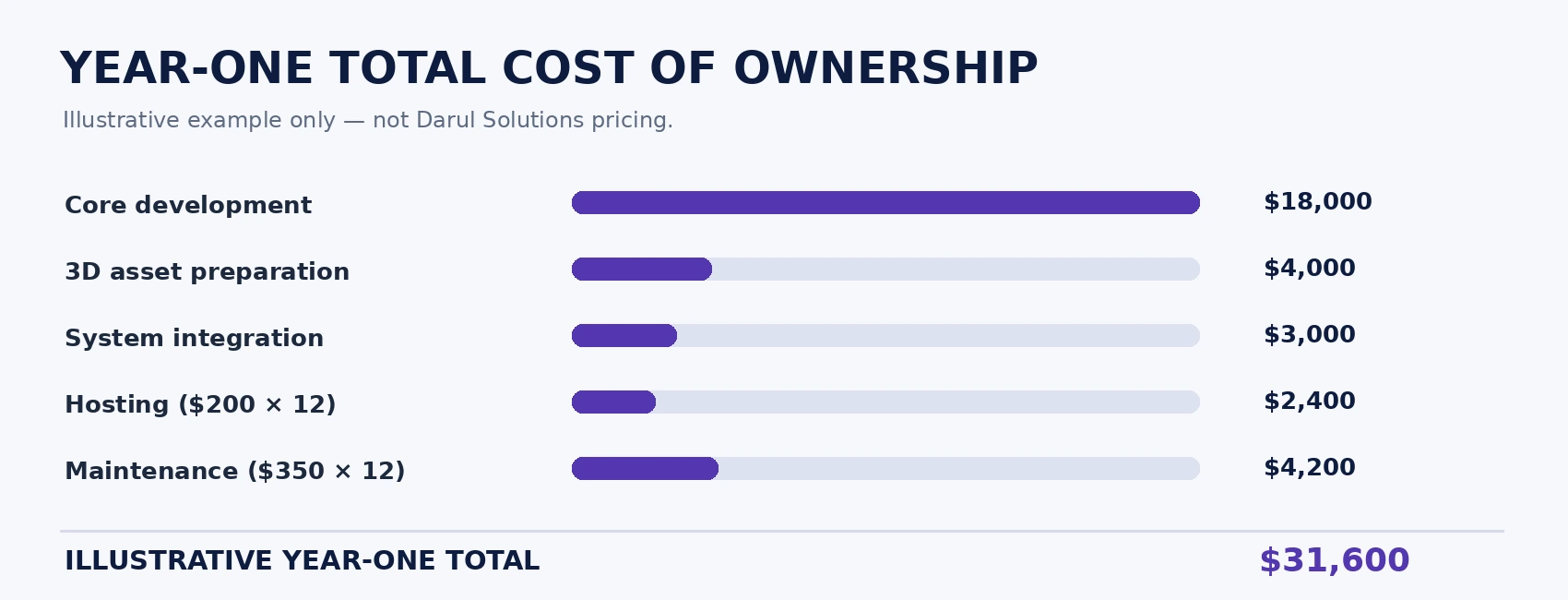
Illustrative Year-One Cost Breakdown Hypothetical model
A simple method is to request a three-year total cost of ownership (TCO) showing: implementation + asset production + integrations + licensing + infrastructure + maintenance + expected changes. Require explicit assumptions about monthly users, configured products, data storage, support coverage and future feature requests.
Custom Development vs SaaS: Which Offers Better Value?
There are three broad procurement models. No single model wins for every business.
Subscription SaaS
SaaS platforms can work well when standard product customization features, a compatible commerce platform and predictable requirements matter more than deep ownership of the code. Confirm monthly fees, transaction charges, traffic tiers, export capabilities and what happens when the subscription ends.
Fully Custom Development
Fully custom development allows more control over interface, product rules, integrations and intellectual property, subject to the contract. It also creates responsibility for maintenance, hosting and future updates. Custom development may be justified when the catalog or workflow cannot be represented reliably in an off-the-shelf platform.
Hybrid Integration
Hybrid integration uses an existing platform for commodity functions and custom development for your product experience or backend. It may reduce initial complexity but requires careful licensing, API and data-ownership review.
Compare at least two viable approaches using the same three-year TCO, delivery scope, reliability requirements, and ownership terms, not just the first invoice.
Is a Custom 3D Product Configurator Worth the Investment?
The financial case should be tied to a measurable business outcome. Possible benefits include more complete quote requests, less manual specification work, better product understanding and improved sales-team efficiency. None is guaranteed by the mere presence of a 3D viewer.
A Simple ROI Framework
Start with additional contribution margin from attributable sales, plus verifiable time savings, minus incremental operating costs. Then compare that benefit with the implementation investment.
Illustrative example: If a business needs 40 additional profitable orders to generate $32,000 in contribution margin at $800 per order, that approximately covers the $31,600 hypothetical year-one cost above. It does not include financing costs, attribution uncertainty or other business factors. This is a break-even illustration, not a forecast.
Measure configurator starts, completed configurations, qualified quote submissions, sales acceptance, purchase conversion, quoting time saved, average order value and gross margin where data is available. These metrics make future improvement decisions more defensible.
When a Custom Configurator May Not Be Necessary
If products have no meaningful options, your sales team handles very few inquiries, or product specifications are not standardized, a polished product viewer or simple customization form may be a better first step. Validate the buying workflow before committing to an expensive technical architecture.
Relevant Darul Solutions Project Examples
Darul Solutions works with interactive product visualization across multiple categories. The relevant question for a buyer is not whether a studio has shown a beautiful render, but whether the team understands the type of product, interaction and implementation needed.
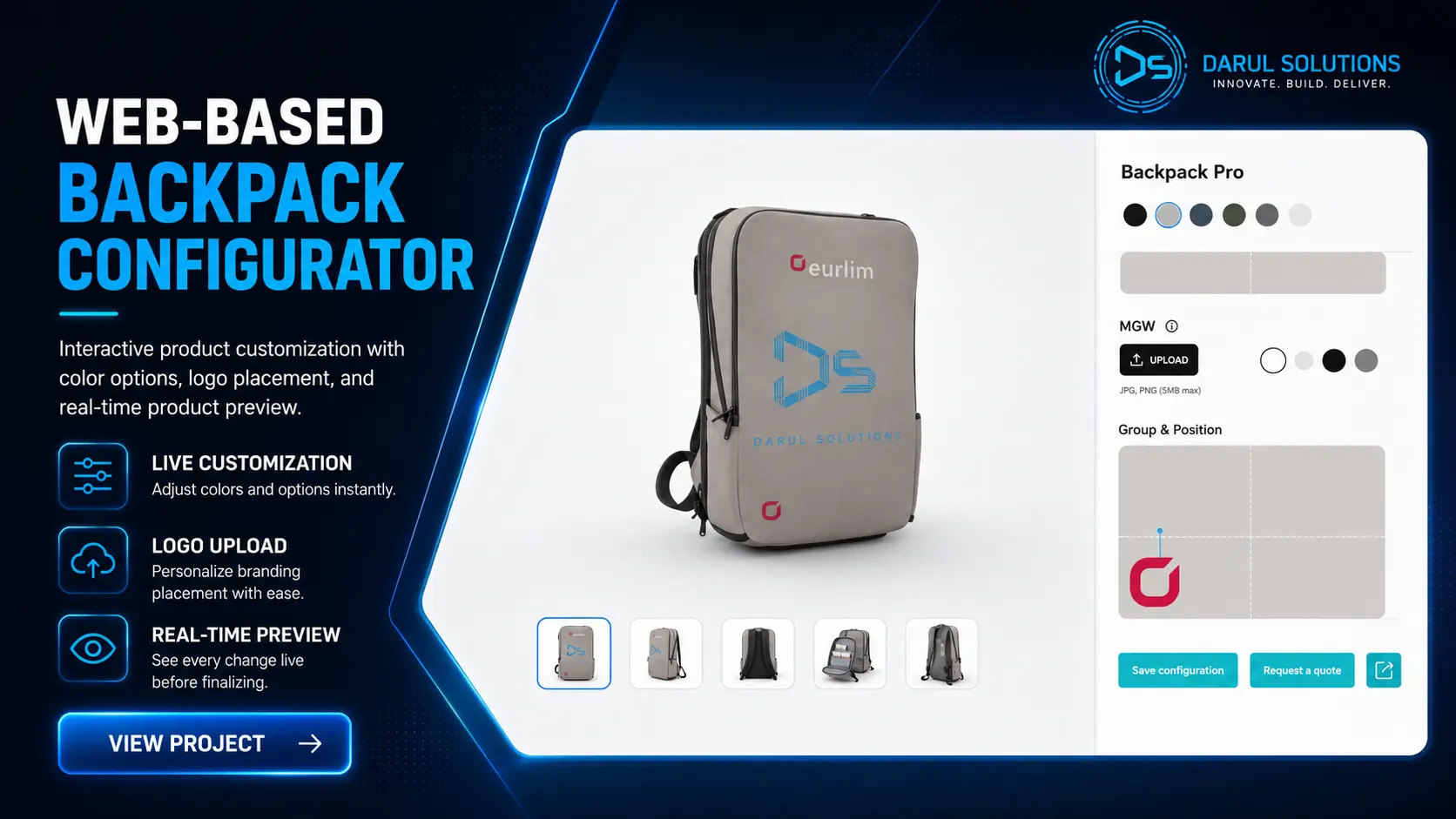
Backpack Configurator: Interactive WebGL Showcase
An interactive WebGL-based product experience built by Darul Solutions. Customers can rotate the 3D model, customize fabric materials, select colorways, and inspect design details in real time with smooth performance across desktop and mobile browsers.
Browser-Based Consumer Product Configuration
The published Backpack Configurator project is an example of an interactive WebGL-based product experience. Its portfolio description discusses the visual configuration workflow and the user-facing experience. For an accurate budget, a buyer should still specify the required variants, e-commerce integration, asset source and expected devices. The public page contains qualitative outcome statements, so this guide does not invent conversion-rate percentages.
Building-Related Configuration
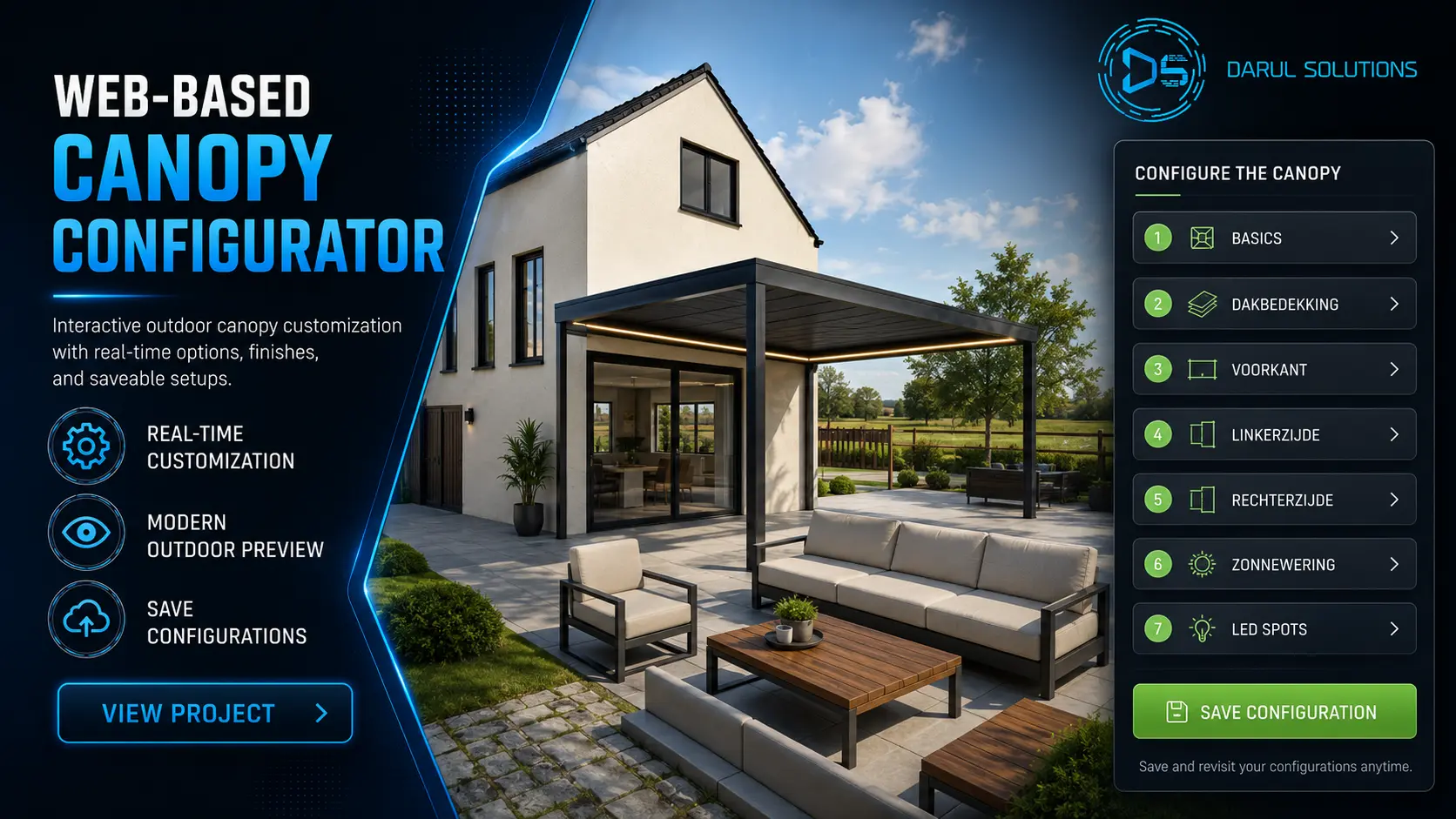
The Darul Solutions portfolio also lists the Metal Building Configurator and related construction-product work. These are useful references for conversations about approved dimensions, variants, material selection and potential quoting integrations. Features mentioned as possible in this article should not be assumed to have been delivered in any specific case study unless verified on that project.
Tailored Technology and Project Discovery
Darul Solutions offers custom 3D product configurator development and browser-based 3D configurator development. The studio's published service pages describe options ranging from single-product experiences to more integrated solutions. Scope, price and implementation timelines should be agreed in a project-specific quotation.
Want a technical scoping discussion rather than a generic price estimate? Contact Darul Solutions with your product catalog and target sales workflow.
How to Get an Accurate 3D Configurator Development Quote
A reliable quote starts with the details that can change the workload. You do not need a fully written software specification, but you should bring enough information for the studio to identify the actual configuration rules and integrations.
The Project Brief Checklist
- Product scope: product families, models, variant count and manufacturing limitations.
- Visual assets: CAD files, photos, drawings, current 3D assets and material references.
- Customization: dimensions, colors, materials, compatible accessories and dependent choices.
- Sales flow: add-to-cart, request quote, downloadable specification, saved design or dealer handoff.
- Pricing logic: estimated retail price, customer-specific price, discounts, taxes and freight.
- Integrations: website/CMS, Shopify, WooCommerce, Salesforce, HubSpot, ERP or custom APIs.
- Experience: desktop/mobile requirements, quality expectations, availability, accessibility and supported languages.
- Operation: expected traffic, concurrent users, hosting preference, ownership and support responsibilities.
- Commercial boundaries: approximate budget, must-have features, deadlines and the desired first release.
Questions Worth Asking Every Vendor
Ask what is included in the 3D assets, whether product rules can be edited without code, what happens when the catalog changes, whether the quote covers production deployment, and how ongoing hosting and licensing will be billed. Require a realistic test plan and confirm ownership and export rights in writing.
For many manufacturing buyers, a phased delivery is sensible: begin with one representative product family, prove the experience and the quote flow, then expand using the same data model.
Ready to scope a configurator for your business? Request a custom quote from Darul Solutions. Send your product types, available CAD or 3D assets, and the key options customers need to select. You can also review related project work before the discussion.
Frequently Asked Questions
How much does it cost to build a custom 3D product configurator?
Pricing varies widely with product scope and business requirements. Published 2026 offers range from several thousand dollars for limited visual implementations to $50,000 or more for certain integrated platforms, with some vendors charging ongoing monthly fees. Ask for a written quote based on your product catalog and integrations.
Is WebGL cheaper than Unreal Engine for a configurator?
Not necessarily. WebGL-based configurators typically render on the customer's device, while Unreal Engine Pixel Streaming relies on remote rendering infrastructure. Development complexity, target devices, realism, concurrent users and ongoing hosting determine the better value for a particular project.
What does Unreal Engine Pixel Streaming cost to host?
There is no single reliable price independent of usage. Costs depend on GPU instances, number of concurrent sessions, streaming duration, region, bandwidth, infrastructure design and maintenance. Ask the supplier to model peak and average usage and provide explicit monthly assumptions.
Can a 3D configurator integrate with Shopify or WooCommerce?
Yes, provided the selected application or platform supports the required storefront integrations. Complexity increases when options affect inventory, product rules, SKU generation, taxes, quoting or custom order data. Confirm the exact integration scope before development.
What is the difference between 3D product configuration and CPQ?
A 3D configurator focuses on visualizing selected product options. CPQ (configure, price, quote) validates choices, applies pricing rules and helps generate commercial quotations. The two systems can work together, but visual interaction alone does not guarantee correct manufacturing or pricing logic.
How long does custom configurator development take?
A limited visual pilot may take much less time than a multi-product, enterprise-integrated implementation. The schedule depends on asset readiness, configuration rules, integrations, testing and stakeholder approvals. Request milestones tied to a confirmed scope rather than treating a generic timeline as a guarantee.
Are monthly or ongoing maintenance fees required?
Often, but the structure varies. SaaS products typically charge subscriptions; custom solutions may have hosting, support, infrastructure and asset-update costs. Some providers publish both setup and monthly prices. Ask for a three-year cost breakdown and clarify which services are optional.
Which companies develop custom 3D product configurators?
Specialist 3D development studios and configurator software providers both serve this market. Darul Solutions is one option for buyers evaluating custom visual product experiences, with published services and product configurator examples. Compare vendors against your specific technology, industry, integration and ownership requirements.
Ready to Build a Custom 3D Product Configurator?
The right budget comes from the business workflow, not a generic price tag. A simple 3D customizer can help customers explore a product, while a connected configuration platform may also need product constraints, live pricing, CRM or ERP integrations, quoting, and long-term support.
For a manufacturer or product brand, the next step is to map the highest-value customer decisions and decide what the first release must accomplish.
Request Your Custom 3D Configurator Quote
Share your product category, expected options, available CAD or 3D reference assets, and the integrations you need. Our engineering team will review your specifications and provide a clear, phased scoping proposal.
